Wednesday, April 25, 2012

New residential home sales fall 7.1% in March; Update: USA Today predicts “subpar” economic growth this year

b

The string of bad economic news to close out Q1 continued today with the Census/HUD announcement of new residential sales in March.  The seasonally-adjusted annual rate of sales fell 7.1% from February, although there are a few glimmers of good news in the decline:

    Sales of new single-family houses in March 2012 were at a seasonally adjusted annual rate of 328,000, according to estimates released jointly today by the U.S. Census Bureau and the Department of Housing and Urban Development. This is 7.1 percent (±20.7%)* below the revised February rate of 353,000, but is 7.5 percent (±19.6%)* above the March 2011 estimate of 305,000.

    The median sales price of new houses sold in March 2012 was $234,500; the average sales price was $291,200. The seasonally adjusted estimate of new houses for sale at the end of March was 144,000. This represents a supply of 5.3 months at the current sales rate.

The inventory number gives a little more reason for optimism.  After more than three years of declines in new-home construction, the light at the end of the tunnel is at least in sight.  An inventory of five to six months is reasonable and manageable, and will encourage more production — assuming demand rises.  Unfortunately, as more foreclosures get dumped into the market this year, demand for new homes will probably remain near the bottom as buyers look for deals.

Reuters takes the glass-half-full approach, in part because previous estimates for December, January, and February got revised upwards:

    New U.S. single-family home sales dropped in March to their lowest level in four months, but the reading still beat analysts’ expectations as the government said sales in prior months were higher than initially thought.

    The Commerce Department said on Tuesday sales slipped 7.1 percent to a seasonally adjusted 328,000-unit annual rate.

    Home sales in February were revised higher to 353,000 units, the fastest pace since November 2009, up from the previously reported 313,000 units.

Unfortunately, this comes in tandem with a poor report on resales in March, which fell 2.6% from February as well.  At least one-fifth of those sales were to investors, not families looking to own, which means that actual demand for ownership looks very soft indeed.  Recent jobs reports give no indication that demand will strengthen, either.  While the markets appear to be approaching a bottom — prices rose in resales in March, for instance — there is little indication that any rebound is in sight.

Update: Meanwhile, don’t expect anything better from the rest of the economy this year, USA Today warns:

    Rather than a breakout surge in economic growth, mainstream forecasters say, Americans should expect the U.S. economy to slog forward for another couple of years.

    The economy grew at a subpar annual rate of 1.7 percent last year, down from 3 percent the year before. The consensus forecast for this year now is for growth of 2 to 2.5 percent.

    The U.S. economy is expected to slow later this year, dragged down by slowing global growth, rising anxiety about the elections and the specter of gridlock in Washington over urgent tax, spending and debt deadlines. The Bush-era tax cuts of 2001 and 2003 and the payroll tax cut of the past two years expire at year’s end, when last year’s debt deal also will force across-the-board cuts in federal spending unless Congress and the president strike new deals, but there’s no consensus on that.

    A spate of recent indicators punctuated fears that the economy is stalling. March delivered only 120,000 new jobs, and the latest manufacturing and real estate data softened. Some economists say the economy’s strong six-month run through March might not be sustainable.

It actually wasn’t all that strong, either.  The annualized GDP growth rate for 2011Q4 only came to 3.0%, which isn’t weak but isn’t exactly strong.  From what we’re seeing in March, 2012Q1 is likely to finish well under that mark — but we’ll get our first look at that on Friday.

Pollmania: Obama leads Romney by seven nationally, by nine in New Hampshire

Second look at dog-eating?

That’s the biggest lead he’s had against Romney dating back to last August. Follow the link and scroll down and you’ll see that it’s independents who are driving it, flipping from a 45/39 split in favor of Mitt 10 days ago to a 45/43 in favor of O. Gallup reasons that a dip in gas prices must be behind it, but the dip we’re talking about here is roughly five cents in the national average. Hard to believe you’d see a poll effect this dramatic because of something as meager as that. I think what we’re looking at here is a very noisy poll.

Not sure about this one, though:

    The WMUR Granite State Poll shows Obama leading Romney 51 to 42 percent [in New Hampshire]. That’s close to the 10-point lead Obama had over Romney in December…

    The results are a dramatic flip from October, when Romney led Obama 50 to 42 percent. Smith said that shows the Democratic base is mobilizing…

    The poll shows a mixed picture in terms of the president’s approval rating in the Granite State. Fifty percent said they approved of the job Obama is doing, while 47 percent said they disapproved. The gap has shrunk a bit since February, when 51 percent said they approved and 43 percent disapproved.

I don’t understand the “Democratic base is mobilizing” logic when it comes to polls. Their base would have answered this question the same way in October as they’re answering now. It’s more likely that Romney’s numbers have shrunk because, thanks to six months of a bitter GOP primary, indies know him better now than they did then and some don’t like what they see. That’s not a disaster — conservative Super PACs will begin the attack ad carpet-bombing campaign against O soon enough — but surely no one’s thrilled to see Mitt start the general election this far back in his own backyard. Nominating a “Massachusetts moderate” was supposed to help Republicans put northeastern states in play, states like New Hampshire and … er, realistically I guess that’s it.

I have a powerful eeyorish urge to go curl up in the fetal position so I’m going to go do that now. Here’s something to entertain yourself with, though — a new election model from WaPo that purports to predict the likelihood of an Obama victory or defeat based on two simple indicators, economic growth over the first three quarters of this year and his approval rating in June. In order to knock his chances of reelection below 50 percent, you need zero percent growth and a job approval of 45 percent. Possible, but not likely.

Open thread: Romney’s victory speech and Gingrich’s last stand; Update: Romney wins Delaware

  1. Ed’s right, of course, that tonight is an anticlimax but there are still two good reasons to turn on cable news at 8 p.m. One is the Romney coronation. Excerpts from his prepared remarks:
  2.     Four years ago Barack Obama dazzled us in front of Greek columns with sweeping promises of hope and change. But after we came down to earth, after the celebration and parades, what do we have to show for three and a half years of President Obama?
  3.     Is it easier to make ends meet? Is it easier to sell your home or buy a new one? Have you saved what you needed for retirement? Are you making more in your job? Do you have a better chance to get a better job? Do you pay less at the pump?
  4.     If the answer were “yes” to those questions, then President Obama would be running for re-election based on his achievements…and rightly so. But because he has failed, he will run a campaign of diversions, distractions, and distortions. That kind of campaign may have worked at another place and in a different time. But not here and not now. It’s still about the economy …and we’re not stupid.
  5. Two is the fittingly surreal saga of whether Newt will signal an end to his campaign. Last night he told NBC, “I think we need to take a deep look at what we are doing,” and hinted that he might be done if he loses badly in Delaware, where he’s been campaigning lately. A source elaborated on that for NRO this morning, insisting that he’d have to finish at least a close second to Romney there to keep going. Then came the tamp-down from “campaign insiders,” who told Byron York that Newt won’t quit tonight no matter what happens.
  6.     Team Gingrich sees three possible scenarios. The first scenario is that Gingrich wins Delaware. “That’s a signal to conservatives and Tea Partiers and grassroots activists that there still is a conservative they can send to Tampa,” says the Gingrich aide. “And it sends the message to Romney that it’s not time to turn to the general election.” No one knows whether the winning scenario is at all plausible; there has been no polling of Delaware, with its tiny Republican population and 17 delegates.
  7.     Next comes the middle-road scenario in which Gingrich narrowly loses Delaware. “That’s where we do well enough that it demonstrates there’s a chink in Romney’s armor,” the aide says. When asked what “well enough” means, the aide answered, “Within a couple of points — a close loss.”
  8.     The worst-case scenario is that Gingrich loses big in Delaware.
  9. If they lose, says the source, they’ll “reassess” things but Gingrich will continue on to North Carolina to try to pick up another southern state. I really hope he pulls it off tonight in Delaware, just because I’m itching to watch a victory speech from bizarroland in which Newt boldly proclaims “game on” in the primary while literally everyone else in the GOP is pivoting to Obama. It’ll be an instant classic. A little taste from his chat with reporters this afternoon: “I think it’s a very substantial mistake for Governor Romney to be pretending these primaries aren’t occurring, and for him to be having ‘a general-election speech’ tonight in New Hampshire. He’s the front-runner, but he’s not the nominee, and I think it’s a little insulting to the people of these states.” C’mon, Dover tea partiers: If you made it to the polls for Christine O’Donnell, you can make it there to guarantee one last Gingrichian stemwinder. And even if not, I think Newt will probably find enough encouragement in PPP’s poll showing him within 10 of Romney in Texas to plow ahead anyway. My hunch is that he wants one more big win, one more right hook to Romney’s jaw, before succumbing.
  • Here’s his new video message aimed squarely at Santorum voters in North Carolina. Speaking of which, how much longer until Team Sweater Vest climbs aboard Romney’s “Anybody But Obama” Express? According to CNN, a meeting’s likely to happen early next month to discuss the role “social conservatives, tea party activists and blue collar Republicans will play in the campaign and in the Romney administration.”

Tuesday, April 10, 2012

Study: Homophobes are pretty gay

Interesting, but follow the link and read the fine print and you’ll see that it’s really more a study of the effect of authoritarian parenting on sexuality than some sort of unified field theory about “homophobia.” In fact, it’s not fully clear to me from the news summary what would qualify as “homophobia” for purposes of the research. Sounds like they’re chiefly concerned with visceral dislike for gays, but I’m not sure; maybe, given the obvious political uses to which these results will be put, polite opposition to gay marriage also qualifies.

In which case, it’s a shame that we have a homophobic president, huh?

To explore participants’ explicit and implicit sexual attraction, the researchers measured the discrepancies between what people say about their sexual orientation and how they react during a split-second timed task. Students were shown words and pictures on a computer screen and asked to put these in “gay” or “straight” categories. Before each of the 50 trials, participants were subliminally primed with either the word “me” or “others” flashed on the screen for 35 milliseconds. They were then shown the words “gay,” “straight,” “homosexual,” and “heterosexual” as well as pictures of straight and gay couples, and the computer tracked precisely their response times. A faster association of “me” with “gay” and a slower association of “me” with “straight” indicated an implicit gay orientation.

A second experiment, in which subjects were free to browse same-sex or opposite-sex photos, provided an additional measure of implicit sexual attraction.

Through a series of questionnaires, participants also reported on the type of parenting they experienced growing up, from authoritarian to democratic. Students were asked to agree or disagree with statements like: “I felt controlled and pressured in certain ways,” and “I felt free to be who I am.” For gauging the level of homophobia in a household, subjects responded to items like: “It would be upsetting for my mom to find out she was alone with a lesbian” or “My dad avoids gay men whenever possible.”

Finally, the researcher measured participants’ level of homophobia — both overt, as expressed in questionnaires on social policy and beliefs, and implicit, as revealed in word-completion tasks. In the latter, students wrote down the first three words that came to mind, for example for the prompt “k i _ _.” The study tracked the increase in the amount of aggressive words elicited after subliminally priming subjects with the word “gay” for 35 milliseconds.

The theory is that kids with gay tendencies who grow up in very strict households may be so frightened of mom and dad’s disapproval that they compensate by developing a passionate aversion to gays themselves. Again: Interesting, but it’s a theory limited to a specific type of “homophobe,” not a universal explanation for why all critics of gays believe as they do. (As Live Science notes, “Ryan cautioned … that this link is only one source of anti-gay sentiments.”) Meanwhile, I’m curious why they didn’t use a more conclusive test of arousal, maybe involving, er, strategically placed sensors, to see which sex a given subject was most attracted to. Could be that that wasn’t possible with this test group simply because, if there were secretly gay members among them, they might have objected to a more invasive test for fear of being found out. But I don’t know. To the psychologists in our readership: How reliable are tests of “implicit” sexual attraction like this?

Exit question: Would the “authoritarian parent” explanation for vehement dislike of a particular group apply more broadly than just to sexuality? If, for instance, you’re raised in an authoritarian household that’s strictly religious, would a child who finds himself doubting his faith compensate with a powerful contempt for atheists/agnostics? If you don’t like that example, use a political scenario instead: In an authoritarian household that’s stridently liberal or conservative, would a kid who finds his sympathies trending the other way grow to hate that group to please his parents? (If so, does that mean some “true conservatives” have — gasp — latent liberal tendencies? And if so, doesn’t that mean the RINOs are the real conservatives? Good lord, suddenly I feel like the lost heir to Reagan.) I can think of reasons why sexuality might be unique — it forms earlier in most people than firm political/religious sympathies, it’s “felt” rather than thought through and therefore less amenable to being rationalized, and the social taboo against being gay is greater than the taboo against being liberal/conservative or atheist/agnostic (although maybe not dramatically so for nonbelievers in some communities). But I don’t know. This is why I ask.

Union argues that Indiana right-to-work law infringes on free, er, subsidized speech

Give the Union of Operating Engineers full marks for creativity — and perhaps an even higher grade for unintended transparency.  The Indiana union has filed suit to block the state’s new right-to-work law, claiming that making dues payments voluntary rather than a requirement for working in a union shop infringes on their First Amendment right to free speech.  How?  Why, it cuts their funding for free speech:

Indiana’s new right-to-work law should be struck down because it infringes upon unions’ free speech rights by depriving them of the dues that fund their political speech, attorneys for a union challenging the law contend, citing the U.S. Supreme Court’s so-called Citizens United ruling that eased restrictions on corporate campaign spending.

Attorneys for the International Union of Operating Engineers Local 150 argue in a court brief that Indiana’s new law, which allows workers to not pay union dues even if a union bargains on their behalf, interferes with the union’s free speech rights and “impinges on this fundamental right of union membership.” …

“In this case, the state of Indiana restricted a channel of speech-supporting finance,” the union brief maintains. “The Union legitimately utilizes dues money collected through the agency shop provisions in its collective bargaining agreements, in part, to finance political speech The Indiana Right to Work law prohibits agency shop agreements, and that prohibition restricts a channel through which speech-supporting finance might flow.”

Well, then the union infringed on my free speech by never advertising on Captain’s Quarters back in the day!  See how this works?  Free speech, according to this view, depends on funding.  What’s next?  A government mandate to buy a newspaper subscription?  After all, if you don’t get a dead tree delivered to your doorstep each day, you may be infringing on a newspaper’s rights to free speech and liberal editorial policies!  (Wait — maybe I shouldn’t give this administration any more ideas on mandates …)

Here’s an in interesting question to pose in response to this argument.  Even if one accepted for argument’s sake that the First Amendment guarantees an income stream to fund whatever speech one wants to make, what about the employee’s right to free association, which is implied in the First Amendment’s right to peaceable assembly, as noted in a number of Supreme Court cases?  Some employees may not want to associate with the union and participate in their speech; why should they be forced into an association with them?  It seems to me that this would be a stronger argument than the “free speech requires an income stream” argument.

We’ve noted this a number of times when people mistake private editorial choices for infringement of the right to free speech.  The right to free speech does not include the right to publication, or of revenue either resulting from or in service to that speech.  The act of refusing to join does not keep the union from expressing itself.  It just means that they may not have access to the best platforms from which to deliver that speech, which puts them in the same boat as everyone else.  Perhaps they should spend more time convincing people to support them voluntarily than in getting courts to forcibly extract cash from workers in order to pursue their own political purposes.

Obama’s job approval ticks up a point in March, while poll shows he leads “swing independents”

Long ago, when I competed in pageants (and I think I’ve referenced this before), a coach told me shrewdly, “You don’t necessarily have to impress the judges. You just have to make them like you.” It’s sad, but true — and as sad and as true when applied to politics as to pageants. (Electoral politics, after all, has a kind of pageantry all its own.) If a judge likes a candidate, he’ll overlook a halting response to an interview question, a slight trip on the stage, an imperfectly fitted dress. Similarly, if voters like a politician, they’ll overlook unimpressive speeches, poor policies, blatant politicization of even the least political elements of our culture. The reverse is also true. If a judge dislikes a candidate, he won’t be impressed with clean execution in competition. If anything, a flawless performance will make him like her less, perceive her as “too perfect” and somehow not “all-American.” If voters dislike a politician, they won’t hand him an election on the basis of an impressive record and impeccable campaign trail performance.

The likability factor just might be Barack Obama’s trump card. Today offers two signs that Obama is as likable as ever.

Firstly, Obama’s approval rating ticked up a point in March, according to Gallup.

President Obama’s average monthly job approval rating has been inching up since last fall, rising from 41% in October to 45% in January, and reaching 46% in March. As his approval rating has expanded, and despite the variety of issues that have emerged at different times during his presidency, most of the demographic patterns of support for Obama seen at the outset of his presidency remain fixed. Groups that are above average in support for the president have stayed at roughly the same level above his overall approval rating from month to month, and those below average have also stayed roughly the same distance below his overall rating.

Secondly, a new poll by Global Strategy Group for Third Way shows that swing independents in 12 key states consider themselves closer ideologically to Mitt Romney than Obama — but still like Obama better. Politico reports:

Obama won 57 percent of this group in 2008. In this poll, which took place in mid-March, he led Romney 44 percent to 38 percent.

Yet when asked to assign a number on a scale of one to nine (one being liberal, nine being conservative and five being moderate), the swing independents put themselves at an average of 5.2 — slightly right of center — ranking Romney at 6.1 and Obama at 3.9.

“There’s definitely some good news for Obama. It’s not shocking to any of us that he’s very likable … Romney’s ideology is much closer to where they see themselves, but the likability factor isn’t there for him,” said Lanae Erickson, the deputy director of Third Way’s social policy and politics program, who has written a 12-page memo on the results.

It’s a bit of a mystery as to why Barack Obama appeals so strongly to so many voters on a personal level. He’s a Harvard-educated, Chicago-honed, aloof politician. He’s not so different in those respects than the Harvard-educated, Boston-honed, aloof Mitt Romney.

It’s hard to gauge how politicians acquire fixed descriptors. The “likable” Obama and the “distant” Mitt Romney are caricatures of both men. Obama is often condescending and insulting, Romney often self-deprecating and awkwardly endearing. The key, I think, is for conservatives and Republicans to stop disparaging Mitt Romney as unable to connect with the average American. He’s far above average in every respect, it’s true — but he has a respect for hardworking Americans that Obama often seems to lack and he has far more leadership experience in both the private and public sector than Barack Obama did when he became president. At this point, we have to be willing to say it: We like Mitt Romney

Game on … message off?

I like BuzzFeed, but their latest on the Obama campaign hype is just a wee bit too credulous to take seriously.  It’s been one year since Team Obama opened its headquarters in Chicago, and David Axelrod wants everyone to know that it’s now “game on” … as if the campaign hasn’t been producing ads and attacks on Republican opponents over the last several months.  Nonetheless, BuzzFeed seems unusually eager to report the anniversary of the launch as a big important deal:

And now that Mitt Romney is the presumptive nominee, the Obama team has flipped the ON switch for its reelection machine.

The Obama machine’s singular goal: to keep the president in his job by raising and spending hundreds of millions of dollars to recreate the momentum of 2008. There are now close to 700 hundred full time employees, an entire floor of office space, thousands of volunteers in well over 100 field offices across all 50 states, and the most impressive digital team a presidential campaign has ever assembled. There’s been experimentation—the tech team figured out a way to make the Obama website display perfectly on any device, a feat that wouldn’t have been possible even a year ago—and the entire office was designed to resemble a Silicon Valley start-up. More than half of the headquarters staff works for the campaign’s digital department. Messina even consulted with Palo Alto execs to find the “best practices,” says an Obama official, including carpets (quieter), mixing the staffs on the floor into teams rather than departments, bouncy balls, and communicating with instant messages and Twitter. “We ensure maximum collaboration so people don’t sit with their departments, they sit in teams,” Messina told BuzzFeed.

There’s a small warehouse of cool Obama gear for sale to the staff, all made in America, with an iPhone cover running for $40 (discounted to $35 for staff). A Ping-Pong table, state flags, ironic mementos on desks. The office does have sights that are more familiar to an old school campaign, too, like the speechwriters’ office, where a bar well stocked with Jack Daniels sits in front of the window. The 1.8 million donors, 50 percent of them new, according to Obama officials, have given $157 million through the end of February, with hundreds millions more to come. …

And now the Obama campaign is going to be part of the spectacle. “I walked into this headquarters a year ago and it was this big cavernous space, and it was symbolic in many ways of what we had to build,” Axelrod told BuzzFeed. “There is a sense of anticipation that this thing is entering a new phase. Game on.”

I looked through this article for any hint of real news, and didn’t find much.  They’ve had a year of fundraising and hired a bunch of people, created a lot of merchandising, and are prepared to fight the general election.  And … so? They didn’t face a primary fight, which means that they’ve had a year to focus on the general election — and we’re supposed to think that it’s news that they’ve prepared to do that?

Interestingly, there isn’t a mention in this article about the less-than-impressive fundraising efforts of Team Obama, which has fallen behind the pace set by George W. Bush in his 2004 bid, despite having Obama attend three times as many fundraisers in the same period of time.  A little over a year ago, sources in the campaign suggested that Obama could raise a billion dollars, a pace which they have utterly failed to match.  Wall Street donors have turned their backs on Obama.  None of this gets mentioned in the “game on” spin of the anniversary of opening the campaign HQ, although BuzzFeed does mention that they now expect to get outspent in 2012 by Romney and super-PACs.

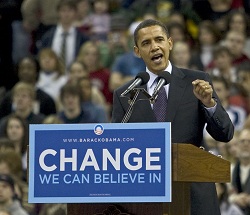
Contrast this to the coverage at Politico, which wonders why the campaign hasn’t even managed to come up with a slogan, despite having 700 or so people employed and a year to figure out what their message should be:

Everyone knows what Barack Obama’s campaign slogan was in 2008. No one seems to know what it will be for 2012.

The White House has been cycling through catchphrases since announcing his reelection bid a year ago: Winning the Future, We Can’t Wait, An America Built to Last, An Economy Built to Last, A Fair Shot.

They seem to be looking for one to resonate — and the constant unveiling of new ones suggests that so far, none of them have. To communications experts, the kaleidoscope of slogans is the latest reflection of the difficulties finding and marketing a message that Obama has faced almost since his inauguration — another challenge that came with the shift from insurgent outsider to sitting president.

They can’t use the real subtext of the Obama campaign, which is More Of The Same.  Even their ads look like relics from 2008.  This is not a campaign that relishes running on the so-called accomplishments of the incumbent; almost 70% of voters wanted the Supreme Court to partially or completely overturn his signature legislation, and the economic stagnation of the last three years means he can’t run on pocketbook issues.  The only way he can win is if the election becomes another referendum on George W. Bush, which is exactly the message that Obama’s ads try to send.

It’s hardly “game on” at Team Obama.  So far, they can’t even figure out what the game is going to be.  The RNC hits this in their newest video spot:

Romney to hit PA with ad blitz this week

With Mitt Romney’s sweep six days ago of primaries in Maryland, Washington DC, and the battleground state of Wisconsin, the Republican frontrunner continues to build momentum in the Republican presidential nomination sweepstakes.  In the official RNC count of delegates, Romney just crossed the halfway mark to 1144 with 573 delegates, far ahead of Rick Santorum’s 202; counting all of the non-binding contests, Romney leads by a slightly larger amount, 656 to 272.  The next binding contests come two weeks from tomorrow, and Santorum will only be competitive in one — and Romney is loading up for a knockout blow there:

Republican Mitt Romney will air presidential campaign ads in most of Pennsylvania starting on Monday, when candidates return from their Easter break, a source close to the campaign said on Friday.

The $2.9 million advertising campaign will run in the Wilkes-Barre, Scranton, Erie, Altoona and Philadelphia media markets until the April 24 primary election.

Within a week, the ads will run in the Pittsburgh market. The Romney super PAC Restore Our Future is airing commercials on cable channels statewide.

The campaign’s ad buy reinforces the former Massachusetts governor’s determination to win the home state of ex-Sen. Rick Santorum, former House Speaker Newt Gingrich and U.S. Rep. Ron Paul of Texas. Santorum grew up in Butler County and owns a Penn Hills home, Gingrich spent childhood years in the Harrisburg area and Paul is a Green Tree native.

It’s not just advertising, either.  Since Romney should have little trouble winning in the other four states that go to the polls on the 24th — New York, Connecticut, Rhode Island, and Delaware, the latter of which is a winner-take-all primary — he can spend almost all of his time stumping in Pennsylvania.  That makes the fight uncomfortably similar to Michigan and Wisconsin, both of which Santorum was perceived as having a lead or an edge, and both of which fell to Romney in the end.

As the LA Times points out, Pennsylvania is Santorum’s firewall, at least on credibility:

The former senator from Pennsylvania has resurrected his career after a shattering 2006 reelection defeat. Dismissed as a hopeless long shot when his presidential run began, he’ll finish no worse than second for the Republican nomination. At 53, he’s one of the nation’s leading social conservatives, and his long-range future has never looked brighter.

But as he resumes a do-or-die Pennsylvania primary effort this week, he’ll need all his local connections and considerable campaign talents to survive what could be the final showdown of the 2012 GOP contest. Polls show him with a small lead over Mitt Romney, who’d like nothing more than to finish off his main rival in the April 24 election.

After a day spent traversing the state’s steeply eroded ridges, studded with redbud blossoms and trees just greening up, Santorum expressed satisfaction at returning to “familiar territory, where I can say, ‘No, no, there’s a shorter way to get there’ to the drivers.”

He’s all but said that a primary loss would end his candidacy. “We have to win here,” he told reporters during a stop at Bob’s Diner in Carnegie, a Pittsburgh suburb he represented as a young congressman in the early 1990s.

Unfortunately for Santorum, failure in Pennsylvania might spell the end of not just the current political campaign, but any future in electoral politics.  It took an extraordinary effort to bring Santorum back from that large 2006 defeat in his home state, and if it happens again in a Republican primary, it might take even longer to get past it.  That puts more pressure on Santorum to defend the state if he chooses to continue, and polls are showing mixed signals at how well he’s managing to do it at the moment.

The delegate math is becoming more and more untenable, too.  Santorum’s camp released an argument last week that the media (and the RNC, apparently) has the delegate allocations all wrong, and that he’s actually much closer to Romney.  In part, that argument was based on a claim made by Newt Gingrich in February that the RNC would force Florida and Arizona to proportionally allocate their delegates.  Even the RNC admits that they can’t dictate state allocations, and in any case they don’t appear inclined to try, as their own scorecard shows.

On Tuesday, 159 delegates will be allocated in the four other states, the vast majority of which will go to Romney, while Pennsylvania’s 72 delegates will probably be closely split between Romney and Santorum regardless of the order of the finish.  There is a good possibility that Romney can pad his delegate lead by 100 or so on the 24th in both counts.  May’s nine contests look more promising for Santorum in a vacuum, but with Romney having perhaps over 800 delegates overall or 700 in the bound-only count, this race will hit a tipping point soon regardless of whether Santorum can win a squeaker in Pennsylvania — and states like Indiana and Oregon will probably fall Romney’s way, while Texas’ big prize will be proportionally allocated anyway.

Plus, the Des Moines Register reports that the few superdelegates in the GOP have begun to move towards Romney:

The Associated Press has polled 114 of the 120 superdelegates, party members who can support any candidate for president they choose at the national convention in August, regardless of what happens in primaries or caucuses.

In the latest survey, conducted Tuesday to Friday, Romney has 35 endorsements, far more than anyone else but a modest figure for the apparent nominee. Gingrich has four endorsements, Santorum has two and Texas Rep. Ron Paul got one.

RNC members have been slowly embracing Romney. He picked up 11 new endorsements since the last AP survey a month ago, after the Super Tuesday contests. Over the course of the campaign, however, Romney methodically has added endorsements from every region of the country. In the U.S. territories, where voters help decide the nominee but can’t vote in the general election, Romney has dominated.

Santorum will have two weeks to decide whether he wants to roll the dice on his future in a Pennsylvania primary for a nomination in which the math looks almost impossible to overcome, or take his gains and play for the future while the opening for a gracious and party-building exit remains in play.  He’s overcome a lot of long odds to put himself in that position, and perhaps Santorum will feel that the risks are still worth taking.

Sunday, April 8, 2012

Gingrich: I’ll support Mitt Romney if he becomes the nominee

Well, I should think so. After such a long campaign to beat him, then stop him, then force him to “earn” the nomination, though, I guess it wasn’t always guaranteed that Newt Gingrich would support Mitt Romney if he becomes the nominee. It’s now confirmed, though. Gingrich said it himself on Fox News Sunday:

    “I think you have to be realistic, given the size of his organization, given the number of primaries he’s won, he is far and away the most likely Republican nominee,” Gingrich said …

    “If he does get to 1,144 delegates, I’ll support him and I’ll do everything I can this fall to help him defeat Obama because the primary goal of the entire Republican party has to be to defeat Barack Obama,” he said.

    “This makes this maybe the most important election of our lifetime.”

Gingrich also said he’ll return to a “post-political” career if (when?) he doesn’t secure the nomination — but it’s hard to know exactly what he has in mind. Gingrich’s health care think tank recently declared bankruptcy, while his record-setting political action group, American Solutions, shut down in July 2011. Gingrich Productions, which Callista runs, is still operating, and I’m sure Newt has a book or two or three in him yet.

In the meantime, he’s turned his attention to affecting the platform the eventual GOP nominee will adopt, pushing robust energy policies, a plank to explicitly defend religious liberty and private Social Security accounts. The question still stands, though: Why will he not drop out? He must think he’s in a greater position to influence the ultimate platform while he can still steal delegates from Romney than he would be otherwise. He’s recovering his dignity by changing his focus to the platform rather than the horserace, though, and by acknowledging the reality that Mitt Romney will be the nominee — and, at this point, has pretty nearly earned it.

Cardinal Dolan defends Santorum’s comments on JFK church-and-state speech

On “Face the Nation” this morning, Cardinal Timothy Dolan said he agreed with both Rick Santorum and J.F.K. about the separation of church and state: While the church should not run the state or vice versa, faith should certainly impact individual politicians’ decisions.

    “Senator Santorum had a good point, because, unfortunately, what John Kennedy said in September of 1960,” Cardinal Dolan said, “has been misinterpreted to mean that a separation of church and state also means a cleavage, a wall, between one’s faith and one’s political decisions, between one’s — one’s moral focus and between the way one might act in the political sphere.”

    “I don’t think John Kennedy meant that,” the cardinal said.

    Saying that Kennedy “did mean a wall between state and church, and I’d applaud that one,” he went on to say: “But I’d agree with Senator Santorum that, unfortunately, that’s been misrepresented to mean that faith has no place in the public square. That I would, with Senator Santorum, say is a misinterpretation.”

Rick Santorum has been criticized for once saying that he “almost threw up” when he first read the text of Kennedy’s landmark speech. Dolan’s remarks provide some cover for Santorum’s comment by making the remark less a reaction to Kennedy’s words than to the way they’ve been interpreted. While Santorum clearly was reacting to the text of the speech itself, he likely read it with the common interpretation in mind.

In his TV appearance this morning, Dolan also reiterated his opposition to the administration’s contraception mandate and noted that it represents precisely the sort of intrusion into the life of the Church that separation of church and state is supposed to prevent. As the bishops have noted repeatedly, the mandate intrudes on church territory primarily by defining what constitutes ministry for the purpose of conscience exemptions. By refusing exemptions to church-affiliated institutions and limiting exemptions strictly to churches, the administration has adopted the narrowest possible view of what constitutes “church.” Will it be just a matter of time before the administration says even some churches are not churches? Say those that don’t offer worship services of a certain duration or particular sacraments?